

Forward Dividend Yield: What It Is, Formula, and Why It Matters
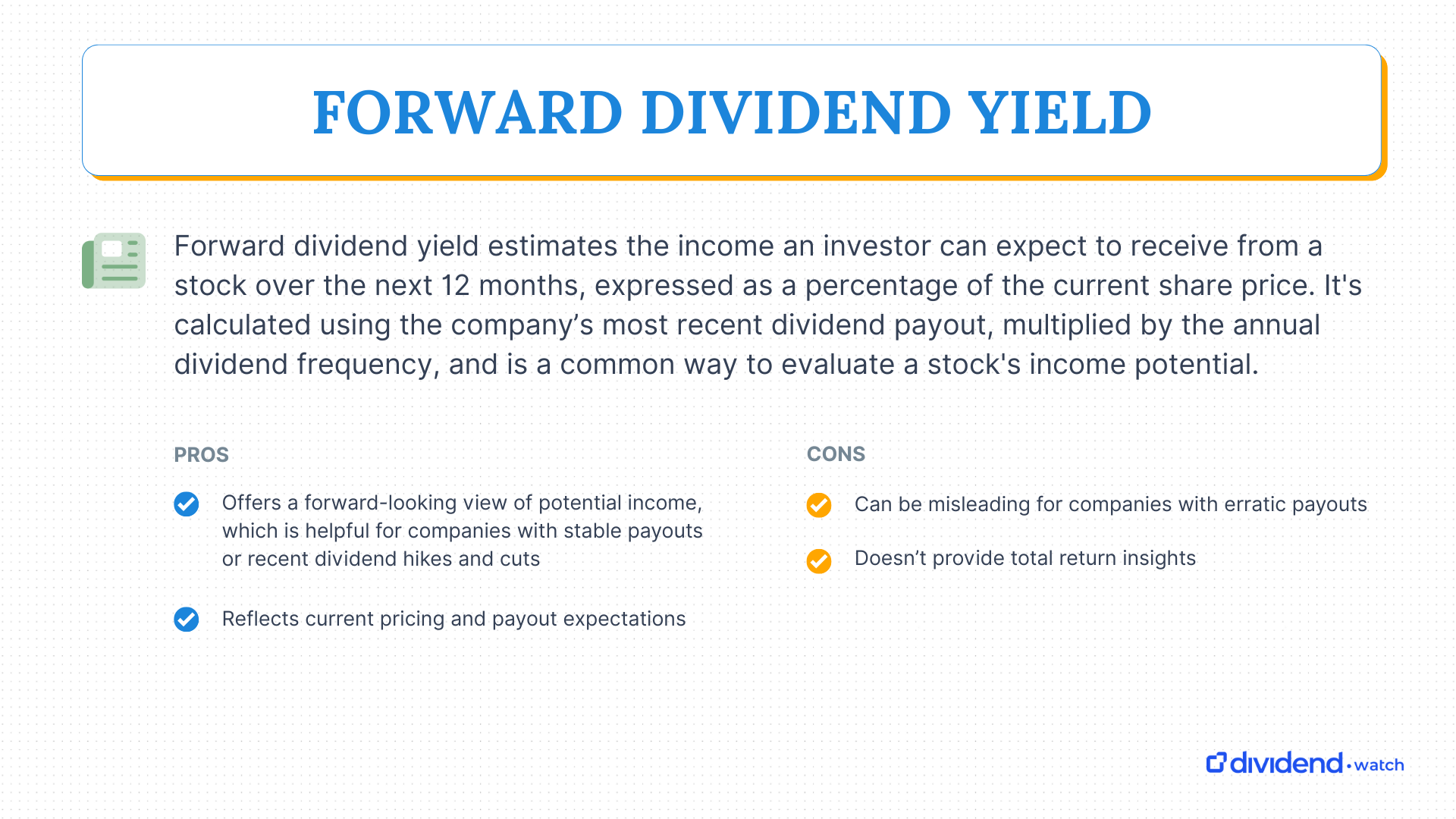
Forward dividend yield estimates the income you can expect to receive from a stock over the next 12 months, expressed as a percentage of the current share price. It's calculated using the company’s most recent dividend payout, multiplied by the annual dividend frequency, and is a common way to evaluate a stock's income potential.
Investors often turn to forward yield as a quick gut check to determine if a stock supports their future income goals or not. For those in retirement or chasing dividend growth, it's like peeking into a financial crystal ball, offering a glimpse of potential cash flow for the next 12 months before committing.
Forward dividend yield formula and example
The formula for forward dividend yield is as follows:
Formula: Forward dividend yield = (Annualized dividend ÷ Current share price) x 100
Let’s walk through examples for quarterly and monthly dividend payers to demonstrate how it’s calculated:
| Company | Frequency | Last Dividend | Annualized Dividend | Stock Price | Fwd Yield |
|---|---|---|---|---|---|
| ABC Corp | Quarterly | $0.50 | $2.00 | $50.00 | 4.0% |
| XYZ REIT | Monthly | $0.10 | $1.20 | $30.00 | 4.0% |
In both examples, we assume dividends will remain consistent over the next year. The forward yield reflects what you would earn in dividends relative to the current price if the payout were to continue.
Why is forward dividend yield important?
Forward dividend yield gives investors a preview of what their income stream could look like over the next year, which is a crucial piece of the puzzle when building a portfolio for predictable cash flow.
Because it reflects the most recent payout and share price, it stays responsive to market shifts, unlike backward-looking metrics, such as trailing dividend yield. That makes it especially helpful when dividend policies are in flux. Used wisely, forward yield becomes more than a stat. It's a real-time, forward-looking signal for income-focused investing.
Using forward yield to analyze dividend stocks
Forward yield is particularly helpful for evaluating:
- Stocks with predictable cash flows and recurring payouts, including REITs, and companies in the utilities, healthcare, consumer staples, and financial sectors.
- Dividend growth stocks, such as Dividend Aristocrats and Dividend Kings, with long histories of predictable increases.
- Stocks that recently raised or cut dividends.
A very high forward yield (e.g., above 6% or 7%) may seem attractive, but it can also signal risk. The company may be over-distributing earnings, putting the payout at risk of being reduced. Alternatively, Investors may be pricing in poor future fundamentals, driving the share price down and forward yield up.
These risks highlight the importance of comparing forward yield with a well-rounded review of other indicators, such as the payout ratio, free cash flow, and dividend history.
Differences between forward yield and trailing yield
The key difference between forward yield and trailing dividend yield comes down to whether insights are historical or future-oriented. In contrast to the forward yield, the trailing dividend yield measures what a company has actually paid out over the past 12 months.
| Metric | Fwd Yield | TTM Yield |
|---|---|---|
| Based on | Future expected dividends | Dividends paid in the trailing 12 months |
| Reflects | Latest declared dividend annualized | Actual historical payments |
| Useful for | Estimating future income | Evaluating dividend history and consistency |
As seen in the table, the trailing dividend yield is grounded in real results, which makes it especially useful when you want to verify consistency or assess a company’s track record before projecting ahead. Knowing the differences, let’s review when it’s best to analyze stocks using either metric.
Use forward dividend yield when:
- A company has recently raised or cut its dividend.
- Evaluating stable companies with consistent dividend payouts, where future changes are unlikely.
- Planning income-focused strategies or retirement cash flow for the next 12 months.
Use trailing dividend yield when:
- You want to verify the reliability of dividend payments.
- Analyzing historical consistency.
How do you find a company's forward yield?
Dividend Watch is a portfolio tracker that provides several yield-based metrics, including trailing dividend yield and the ability to easily calculate the forward yield.
Reviewing the scenario below for a Dividend Watch portfolio holding Johnson and Johnson (JNJ), you can see the current dividend yield displayed prominently, along with a dividend history of quarterly payouts. The payout of $1.30 annualized is $5.20, which results in a forward dividend yield of 3.66% based on the current price.
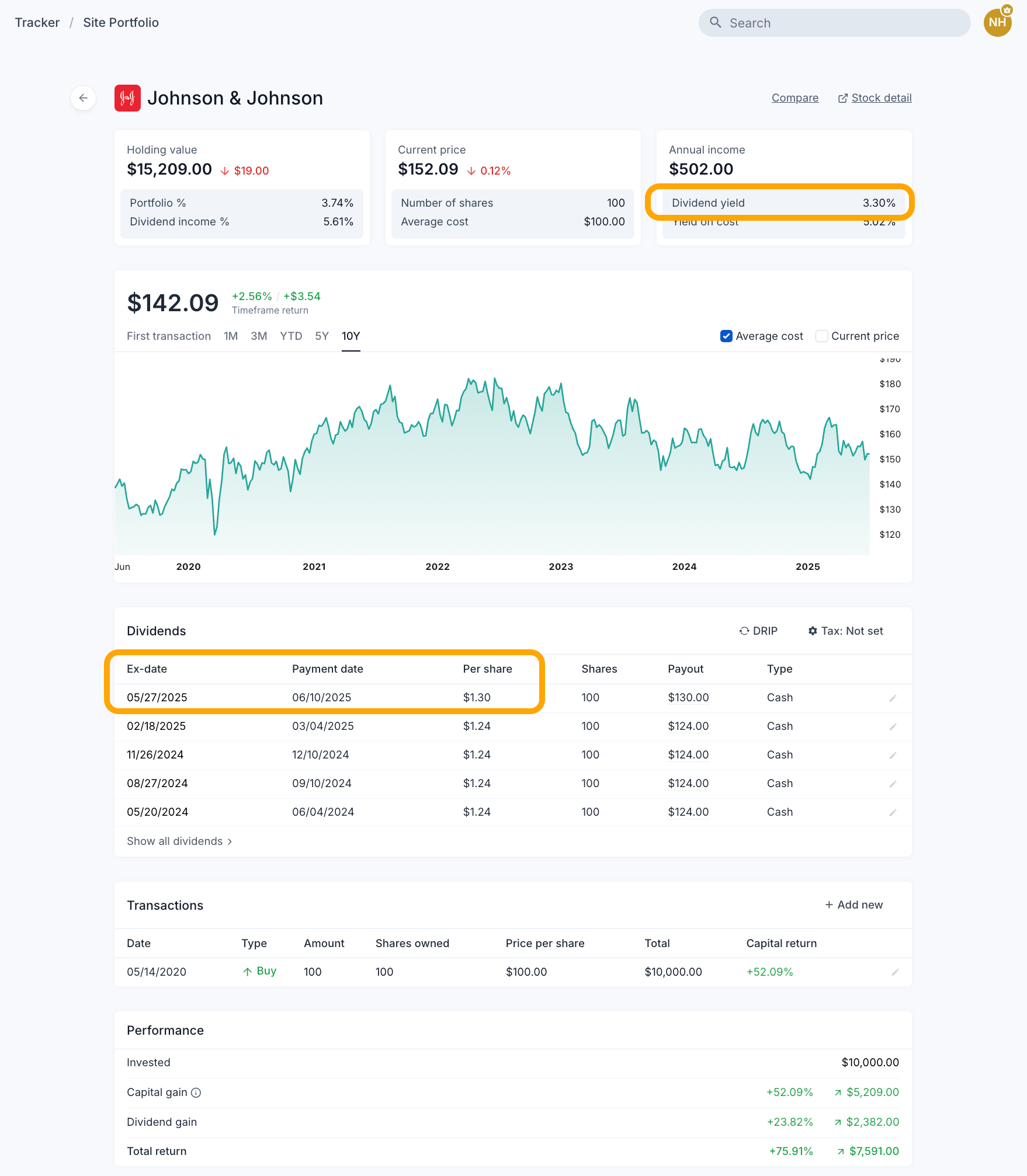
Dividend Watch makes it easy to analyze the forward dividend yield for stocks in your tracked portfolio. Souce: Dividend Watch
FAQ
What's a good forward dividend yield percentage?
For many dividend growth investors, a forward yield of 1% to 4% from stable companies is attractive. For high-yield stocks, yields of 5% to 8% may be acceptable with added due diligence, especially as yields approach double digits, which reduces the remaining profit available for growth reinvestments.
Are forward dividend and forward dividend yield different?
Yes. The forward dividend refers to the projected dollar amount (e.g., $2.00 annually), while the forward dividend yield expresses that amount as a percentage of the stock price (e.g., 4%).


